
Full throttle. Foot flat on the floor, motor howling, and the energy meter read 30 amps.
That number is the reason our car had slow acceleration for most of a season. It is also the reason I now measure before I argue. Our pack and our controller were built to move a car down a straight. We were feeding them roughly what a hair dryer draws. And for weeks, we blamed the gear ratio.
I’m the electrical systems lead on a student-built EV race car: Create Our Car (COC) at Chung-Ang University, running in the EV class of Formula Student Korea. This was the cheapest fix we ever made, and it came after the most expensive assumption we ever made.
The short version: a slow EV with no fault code is usually not a mechanical problem. It’s a limit. The controller decides how much current it is willing to pull from the battery, and if that number is set low, the car will be obediently, uncomplainingly slow forever.
Why an EV Can Feel Slow With Nothing Broken
An electric motor’s torque tracks its current. More current, more shove. What’s less obvious is that the motor never decides that — the controller does, and the controller obeys a table of numbers somebody typed in.
There’s a ceiling parameter for how much DC current the controller will draw from the battery. On ours it was called Battery Main Current. Set it low and everything still works: the pack is fine, the motor is fine, no error code, no beep, no limp-mode light. The car just doesn’t pull.
That’s what makes it so easy to misdiagnose. A broken thing announces itself. A conservative number sits there quietly and lets you blame your gearbox.
We Blamed the Gear Ratio. Then We Measured.
By the time we got to our test at the Anseong campus, the car had already eaten a season’s worth of bad luck. Our first Kelly KLS8080N controller died the night before test week — twelve volts on the wrong pin — and the replacement came down from another university by train the next morning. The second one died the night before Anseong. We drove to Gachon University and picked up a Golden Motor VEC500 at 2 a.m.
Test week itself was mostly a write-off. The Grandeur pedal we had bought wasn’t compatible with the controller, and the working Kelly pedal only arrived with a teammate on the last morning — a story I’ve already told through the pedal’s voltage. Three days at the track, and we ran on one of them. Other teams were flying past. We were slow enough that running alongside them wasn’t really an option.
So we did what tired people do. We built a theory. The gearing must be too tall — that’s why the car won’t accelerate. We talked about sprockets. We talked about the final drive. We talked about it for weeks. The thing about a theory you like is that it’s free to hold and expensive to keep.
Then at Anseong, instead of arguing, I pulled up the energy meter. It logged to a web dashboard, so I could read the car’s live current straight off my phone. Full throttle: 30 amps. Not 200. Thirty.
One Parameter: Battery Main Current
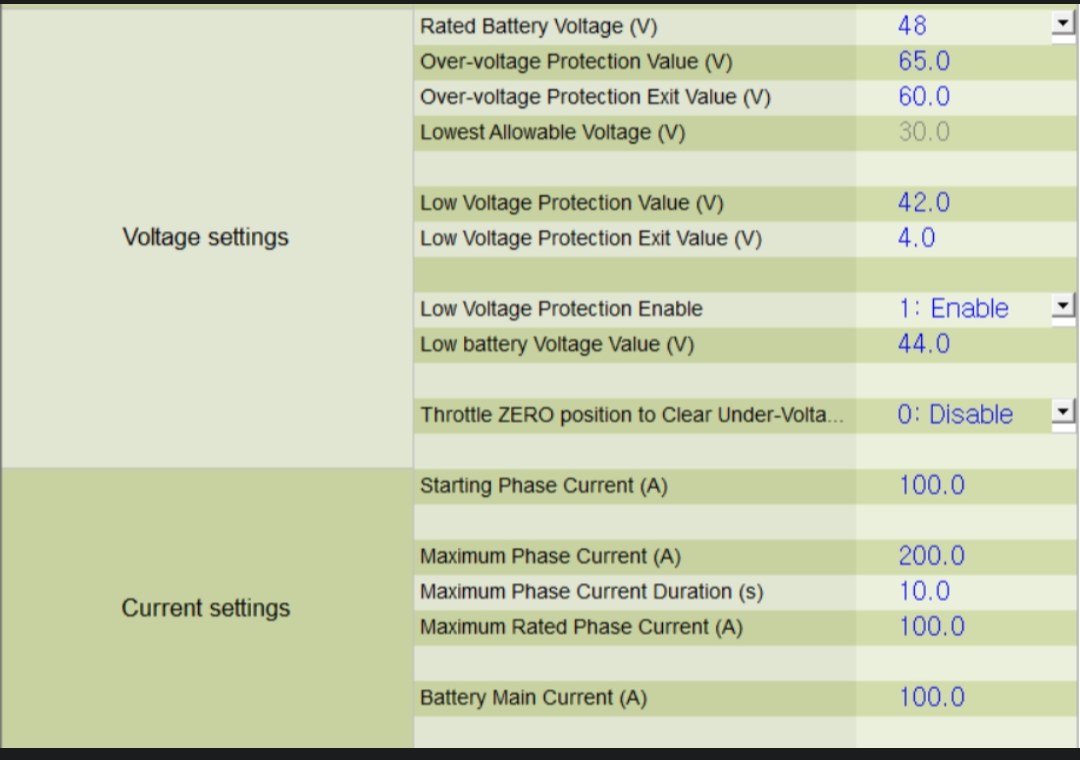
I plugged a laptop into the controller and opened the parameter software. Battery Main Current was sitting at 60 A. Our handover report has it written down: 60 amps, straight from the defaults, on a car that was supposed to race.
Why the meter showed 30 A rather than the full 60 A, I never nailed down — we never put the controller on a bench afterwards, so that gap is still an open question. The ceiling was low enough that it stopped mattering.
Here’s the part I’m less proud of: we didn’t max it out. We chickened out. Our main cable was 1 AWG and the rating we had read for it was around 100 A. We ran two of them, assumed a 200 A ceiling, and stayed well under it. The numbers we typed into the VEC500 that afternoon were timid:
- Rated Battery Voltage: 48 V
- Starting Phase Current: 100 A
- Maximum Phase Current: 200 A (10 s duration)
- Maximum Rated Phase Current: 100 A
- Battery Main Current: 60 A → 100 A
We turned it on. The car left. It went from something you could jog alongside to something that would genuinely take off — one parameter, about ten minutes of work, and the difference isn’t subtle.
Twenty minutes of grinning later, we ran a hard braking test.
A Week Before the Race, We Stopped Being Polite
The car was quick, but the launch still felt soft off the line. One week before the competition, at a test session in Jamsil, we went back into the parameters and stopped hedging:
- Starting Phase Current: 100 A → 150 A (we ran it as high as 180 A)
- Maximum Phase Current: 200 A → 185 A
- Maximum Rated Phase Current: 100 A → 180 A
- Battery Main Current: 100 A → 185 A
At roughly 50 volts under load, 185 A is about 9 kW — which mattered, because the competition capped us at 10 kW and metered it with an energy meter that later cost us a whole day of scores. Raising phase current is also how you cook a controller, so the thing we watched all day wasn’t the speedo. It was the water-cooling temperature. If that had climbed, the numbers were coming back down.
That was the fastest the car ever felt.
If Your Formula Student Car Feels Slow, Do This in Order
If your car is slow and nothing is throwing a fault code, do not touch the drivetrain yet. On a student EV with a healthy pack, a slow car is almost always a number somebody typed in, not a sprocket somebody chose. Here is the order I wish we had followed.
- Measure current at full throttle before you argue about anything. A clamp meter on the main DC lead, or the energy meter the rules already make you carry. It takes two minutes. If the number sits far below what your pack and controller are rated for, you have a limit, not a gearing problem.
- Read the controller’s parameters before you assume they’re sane. Ours shipped with Battery Main Current at 60 A on a car built to race. Defaults are written for the most timid possible version of your hardware, and nobody on the team had ever opened that screen.
- Let the cable set the ceiling, not your courage. Our main run was 1 AWG, doubled, and we kept the limit well under what we believed that could carry. Raise a current limit above what your harness can handle and you haven’t built a fast car — you’ve built a heater with a steering wheel.
- Raise limits in steps and watch a temperature, not the speedo. Phase current is how you cook a controller. At Jamsil the thing we stared at all day was the water-cooling temperature. If it had climbed, the numbers were coming straight back down.
- Check the rulebook’s power cap before you tune, not after. Ours capped every car at 10 kW and metered it. At roughly 50 V under load, 185 A is about 9 kW — deliberately, carefully under the line. Tuning first and reading the rules second is how a fast car scores nothing.
And the warning I would give any new team member on day one: an assumption is not a measurement. We had a wonderful theory about our gear ratio. It was free to believe, we believed it for weeks, and it cost us a test week we never got back. Whatever you measure, write it into the handover report the same day — the team that inherits this car next year will inherit the wiring, but not your memory of it.
Back to that hard braking test at Anseong. The car was finally fast enough to load the chassis properly, and I stood on the brakes to see what it would do.
The left suspension arm broke.
Series: This is part of Field Notes — everything that broke on our Formula Student EV car, in the order it broke.